Food inequality, health, Ultra processed food, Uncategorized, UPF

Pies and Piety

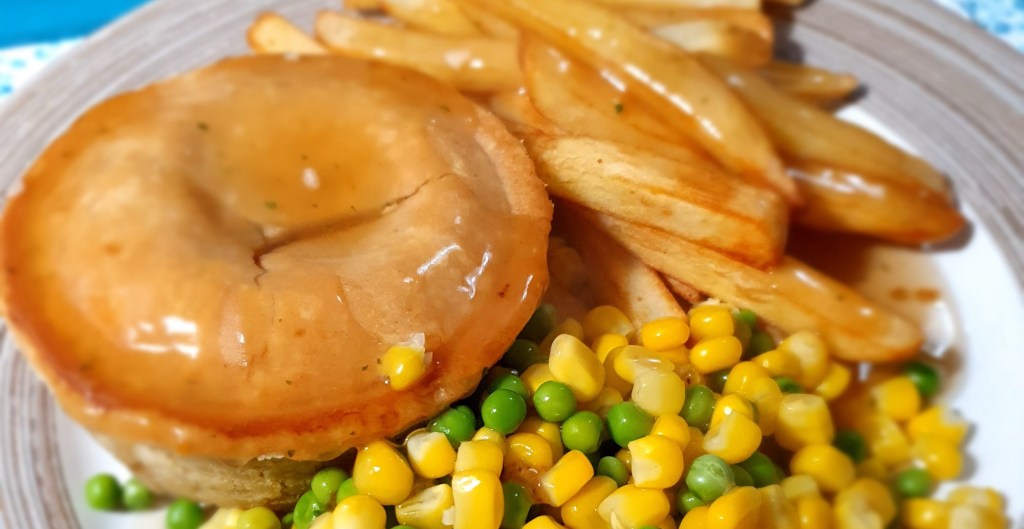
Vegan gluten-free pie, oven chips and frozen vegetables.

Anyone else getting a bit frustrated with the anti-UPF crowd?

Even if you don’t follow the news about health or nutrition you must have heard about UPF (Ultra Processed Food). It’s been everywhere for at least a couple of years now. There have been documentaries, podcasts, books and numerous magazine articles, not to mention the countless social media posts from “experts” with very disparate levels of actual expertise. Therefore, I’m not going to talk about what UPF is. You can find a simple explanation here.

For people who have a basic education about these things, it seems obvious that a diet high in ultra-processed foods is not ideal. In an ideal world, we’d all be cooking nutritious meals from scratch every day. I don’t have any issues with this in theory. I would literally love it if this were achievable for everyone.

However, my problem is that the people who seem to be demonising UPF at every turn, tend to be privileged, middle class, media types who have the means to do this. They are either deliberately ignoring the situations that huge chunks of the rest of the country find themselves in or they are genuinely unaware, which may actually be worse.

In the UK, in 2023/24, 3.12million people used foodbanks. If you’ve ever donated to a foodbank, you’ll know that what they want is non perishable, long-life food items. You might think that’s because these products are logistically easier for the foodbanks to deal with, which they are, but there is another important reason. A report in 2020 found that :-

900,000 people in the UK were living without a fridge (1 in 30 earning under £35,000 a year)

1.9 million people were living without a cooker (1 in 20)

2.8 million people living without a freezer (1 in 10)

When you know these statistics it’s easy to see why lots of people rely on processed/ ultra processed food. People often rant about how cheap and easy it is to batch cook your meals for the week rather than eat ready meals or Pot Noodles but how are supposed to do that if they don’t have a cooker? Where are they supposed to store these meals if they don’t have a fridge or freezer? Your “35p a portion” home-cooked meals cost you 35p because you have a lot of the ingredients in your well-stocked cupboards. If you had to go out and buy all your herbs, spices, sauces, oils etc again, how much would it cost? It’s reminiscent of Terry Pratchett’s “Vimes ‘Boots’ theory of socioeconomic unfairness” and is just not realistic for a LOT of people. When people have hungry kids to feed on next to nothing can you blame them for choosing the 85p 6-pack of crisps that will give them 135 calories over the 99p 6-pack of small apples that will give them about 50? If you really want to improve people’s health you need to help people living in poverty, campaign to reduce food prices, increase access to safe, affordable housing, lower energy prices and all manner of other things that will make it easier for them to eat less UPF and stop blaming them for a “choice” which is often largely out of their control.

I have more to say about UPF but I’ll save that for another day, so until then I’ll leave you with this position statement, made earlier this year by the British Nutrition Foundation on the concept of Ultra Processed Foods :

Our position 

A number of countries advise the reduction or avoidance of ‘ultra-processed foods’ (UPF), a category of foods described within the NOVA classification system by the ‘extent’, ‘purpose’ and ‘nature’ of food processing, within national dietary guidelines. This is based on evidence, largely from observational studies, linking high intakes of UPF with poor health outcomes including heart disease, type 2 diabetes, obesity and cancer. Although such studies have shown consistent associations, it is difficult to untangle the impact of less healthy dietary patterns and lifestyles and they do not provide clear evidence of a causal association between processing per se and health.  At present in the UK there is no agreed definition for UPF and they are not referred to in government dietary recommendations.

Remember folks, correlation does not equal causation!
health, Uncategorized

Can I get a do-over for January?

Ill again … 😔

I had such high hopes for this year. As I said a couple of posts ago, 2023 was a bit of a write off but I thought I was going into 2024 mostly recovered and ready to claw my health back. Well, “the best laid plans” and all that.

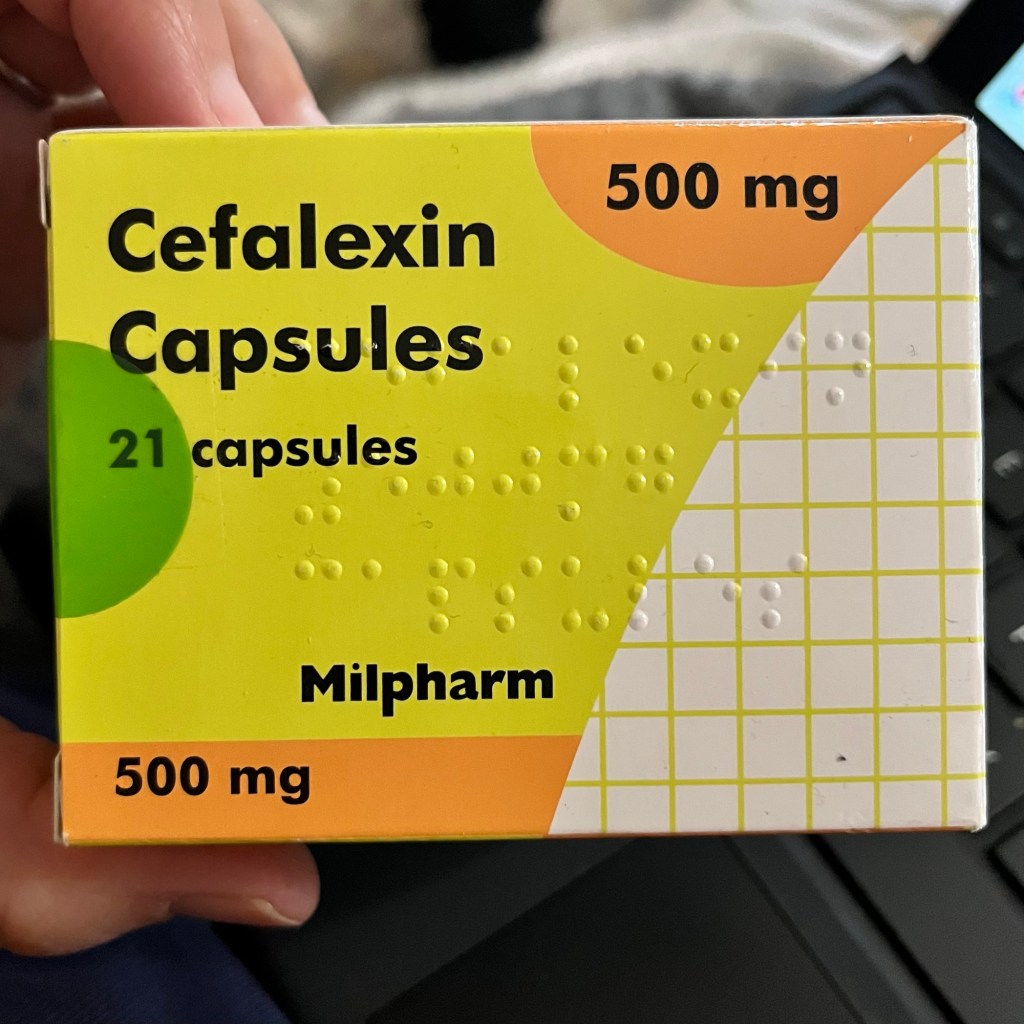
Last Tuesday I finished my lunch and promptly vomited it all back up 🤢 I didn’t really feel much worse than usual, and it was just one episode, so I called my husband and asked him to pick MiniMe up from school just in case, but assumed I’d eaten something that hadn’t agreed with me. I didn’t eat much for the rest of the day. I couldn’t face the delicious curry I’d made for dinner the night before as I still felt queasy, but I managed a bit of tea and toast and didn’t think much more of it. Until I started trying to remember if this had happened before and realised it had, in my early 20s, when I was going through a particularly bad spell of recurrent kidney infections . I only have one kidney, and it a duplex, which makes me more prone to infection. The difficulty is that I also don’t usually get any symptoms other than back pain, and these days I have back pain all the time! Luckily, because of my history, I always have a week’s worth of antibiotics at home and I’d just bought some new urine test strips so I did a quick check. My leukocytes and nitrites, both signs of infection, were positive, so I started the antibiotics that night.

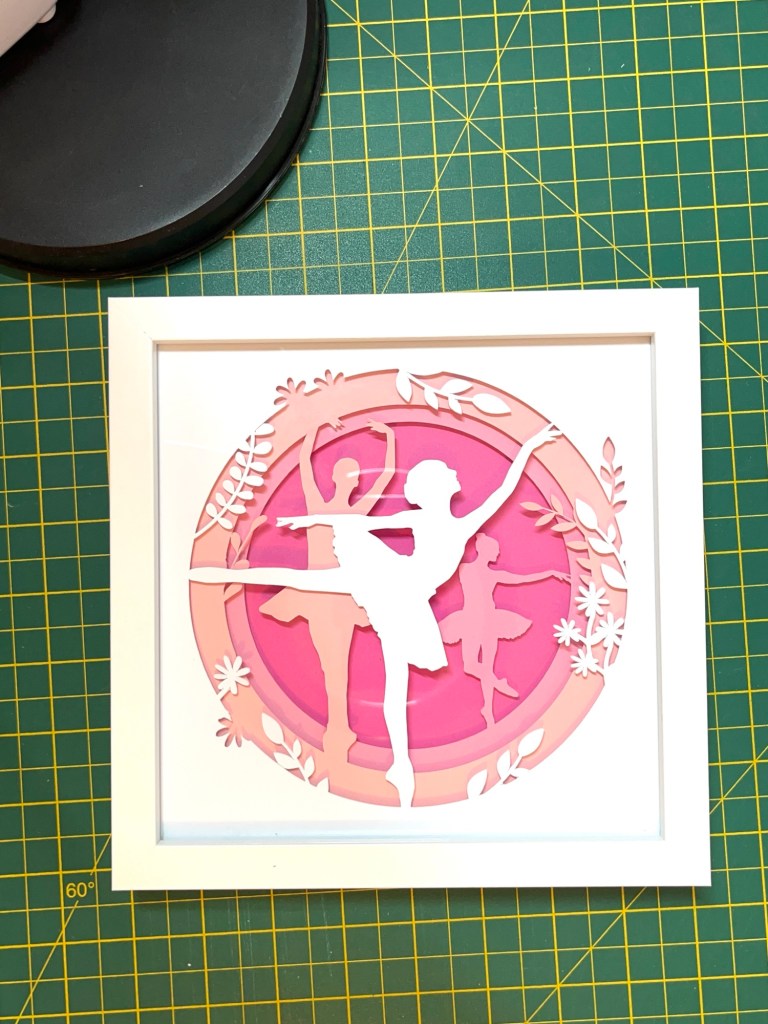
Luckily, within a day or two I felt much better and I’ve been resting lots and drinking lots of water. I look the last capsule a few days ago and have been trying to get a few chores done each day without over doing it. I donated a prize to an event that happened last Friday (I make gift frames and ggreetings cards),

so I have made a start on making that and am sorting out some of the clutter in the house in the hope of being able to clear enough space to put a mat down in the living room and actually start doing some exercise! Wish me luck!

health, Uncategorized

January déjà vu.

Well, I’m trying but, as usual, my body has other ideas!

When I’ve lost weight before I did it with WeightWatchers and obsessively tracked every morsel that passed my lips. I don’t recommend WW for a variety of reasons but I do think tracking can be a good idea if you want to lose weight or just improve your diet. Not as a permanent measure but accurately tracking your food for a few weeks can help you understand where your excess calories are coming from or where you might have gaps in your diet that might require changes or supplements.

Anyway, I started tracking last Monday using MyFitnessPal. I really like this app for tracking but the default calorie goal is very low so if you use it – or any other tracking app – please set your own healthy, achievable goals.

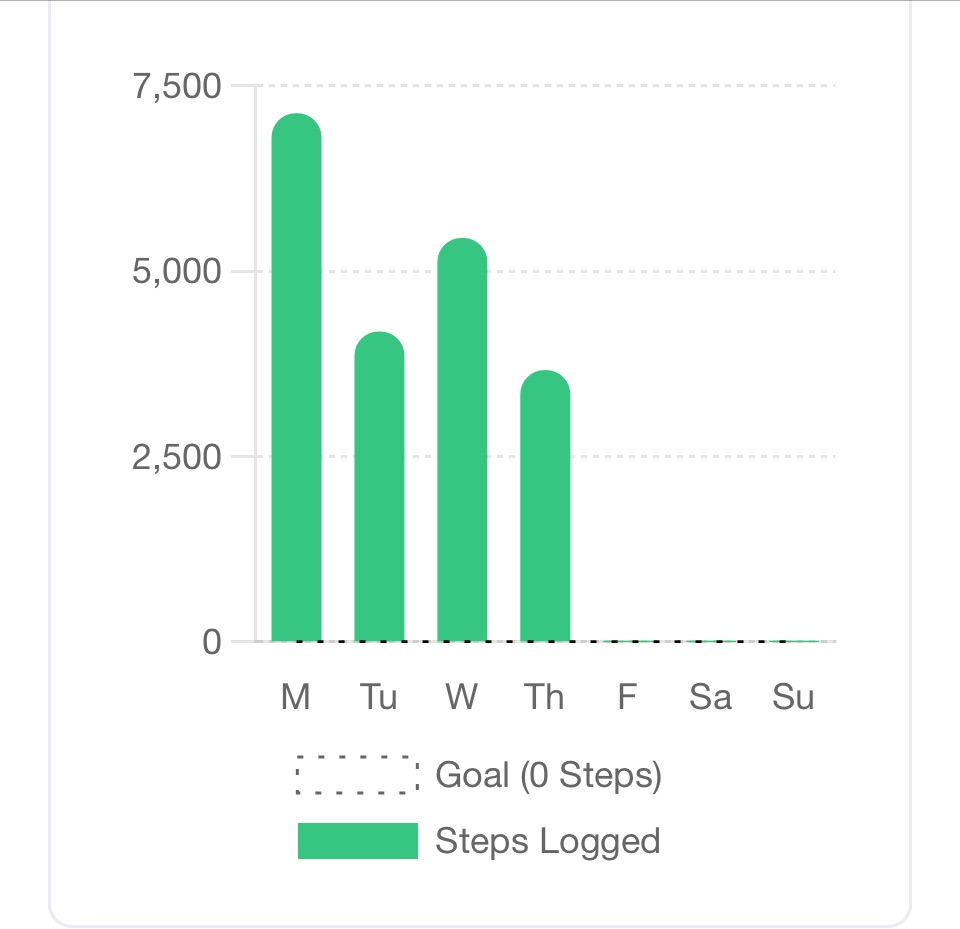
As well as eating healthily I walked my dog every day after I’d dropped my daughter off at school. She can be quite a reluctant walker but she is usually happy to do a lap of the school if it’s not too cold, and there is quite a lot of incline so, even though it’s not a super long walk, it’s quite a good workout for us both (she has recently recovered from a hip injury too).

Unfortunately, my new regime only lasted until Wednesday, when I pulled a hip muscle getting out of my car.

Not 100% accurate but not far off!

It was phenomenally painful and put me out of action for a few days, and also led to me eating chocolate etc to cheer myself up. A couple of bars of chocolate are not the end of the world, but it wasn’t the best start to the year, and I was a bit worried that I was heading for a repeat of last year’s IT band injury. Luckily, after a few days of rest and an Epsom salt bath, my hip feels much better. I managed to walk the dog and take her to agility yesterday, though she is (quite understandably) hibernating today!

Ellie at agility class.

Fingers crossed it’s warmer tomorrow and I can convince her to join me for a lap!

health, Uncategorized

Health Reboot

Happy New Year! How are we all doing? Good Christmas? etc….

Right, now that’s out of the way, let’s get down to business. I have never wanted to write a “diet” blog. I want to talk about nutrition and general health issues but I will never preach about weight loss. Whilst I do believe carrying a large amount of “extra” weight can have health implications, if you’re happy as you are, then you crack on. We’re all adults here and are responsible for ourselves and I don’t offer unsolicited advice or make comments about the size of peoples bodies. I’m obviously happy to help anyone who wants to lose weight but I won’t suggest that you should.

However…I am NOT happy with my body and weight at the moment. Since I hit my target weight (another phrase I avoid nowadays!) the week before the first lockdown I have steadily regained all the weight I lost and more, and with a history of heart attack, stroke and Type II diabetes in my family, I think it’s in my best interests to lose a few stone (lbs if you’re in the US, kgs if you’re anywhere else ) and, more importantly, some inches off my waist, so I may talk about MY attempts at weight loss.

2023 was a total write-off for me, healthwise, which has led to me being heavier than ever. I started the year with a ruptured IT band, which is probably the post painful thing I have ever endured ( and I gave birth to a child with 91st percentile head circumference – episiotomy, forceps, stitches- the lot!) I could hardly walk for several months (after the injury, not the birth!) so, obviously, there was very little exercise on the cards.

By May I was pretty much back to normal which, for me, is still quite a lot of pain. I did try to at least do a bit more walking though, and things were going well until mid July, when I got Covid for the first time.

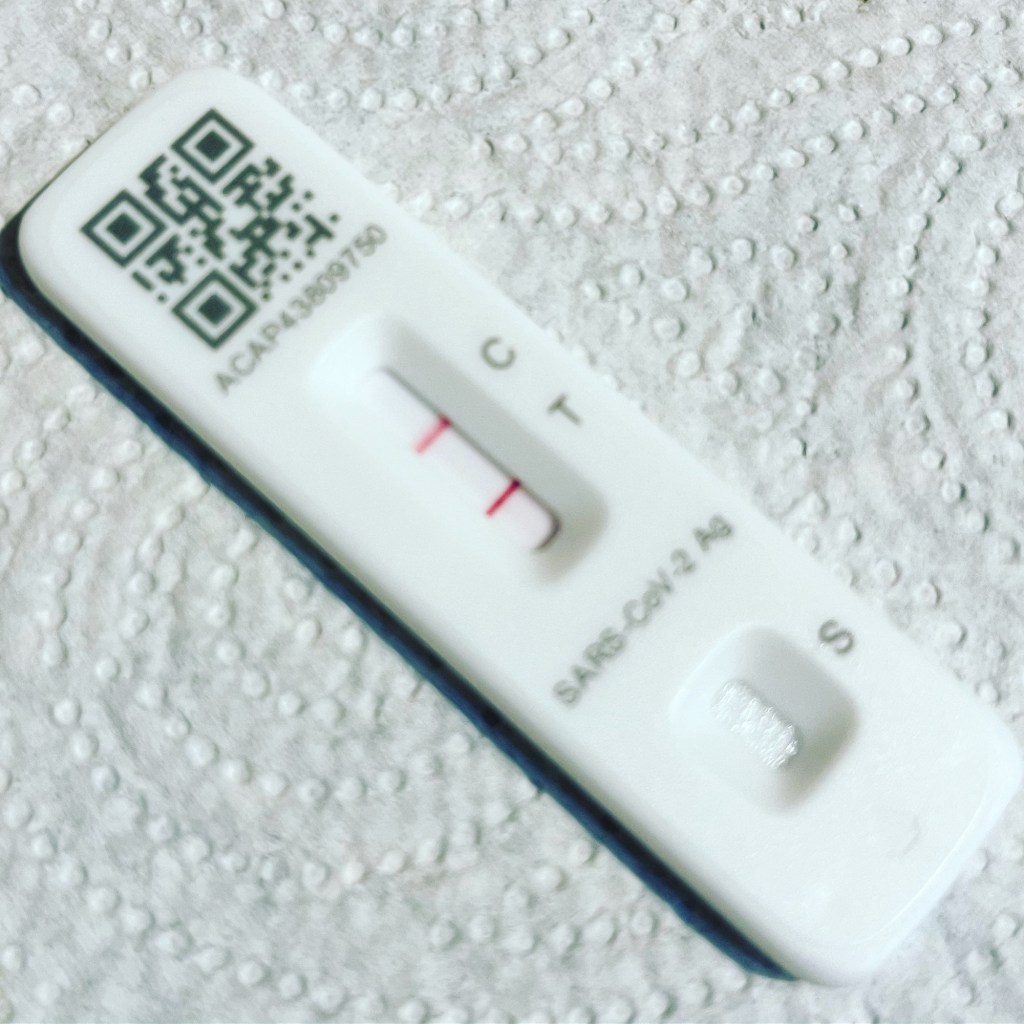
It completely wiped me out for the first couple of weeks. I could barely lift my head up a lot of the time and just about managed to get to the bathroom (about 10ft away). By the end of the summer holidays I was almost back to normal but was still getting tired very, very easily. This meant I had to carry on driving my daughter to school etc as walking would have written off the rest of the day. I was gradually building my strength up though, when I got Covid again in December. Luckily, I wasn’t anywhere near as ill as the first time, but it was still a week and a half stuck at home, followed by the Christmas holidays, when everything goes to pot anyway.

Throw into the mix my dog getting injured and needing months of hydrotherapy, which meant fewer/no walks for us both, no agility class and some missed school visits (we volunteer through the Pets as Therapy Read 2 Dogs scheme),

my daughter picking up more bugs than she ever has before – including Covid again, her also having her first proper allergic reaction since she was 18 months old and three deaths in the family and 2023 was a bit trying to say the least!

So, hopefully, 2024 is going to be different! Obviously, all of 2023’s mishaps were out of my control but my plan for this year is to improve my health. I am going to put my nutrition coaching skills into practice on myself and I’ve signed up to a specialist app for EDS/HSD sufferers to try and improve my strength. I won’t be focussing on losing weight but I am hoping that at least a bit of weight loss happens as a result of the improvements I make to my diet and my increased activity levels. I’m also going to actually post on here a bit more often! My dusty fitness tracker is charging and will be ready to go in the morning. Just hope I am too! 😁

Uncategorized

Vitamin D

Vitamin D has been in the news a lot over the last few years, so let’s have a look at it.

Photo by Jill Wellington on Pexels.com

After my blood tests showed I was deficient in vitamin D as well as iron, I decided I’d write a post about it at some point, particularly as it’s been suggested that it can reduce the severity of Covid 19. As it was trending on Twitter a couple of days ago and popped up several times on my Instagram feed I took that as a sign that now was the time!

So..what is vitamin D?

Vitamin D is actually a family of related substances, the most common of which are D2 and D3.

Why do you need it?

It promotes the absorption of calcium and helps regulate the levels of calcium and phosphate in the blood.

It helps to regulate bone growth and repair.

It reduces inflammation.

It modulates processes such as cell growth, neuromuscular and immune function, as well as glucose metabolism.

In short, it’s really important for our bones, teeth and muscles. A deficiency in vitamin D can lead to rickets in children and osteomalacia in adults. Sufficient vitamin D and calcium also help to protect against osteoporosis.

Where do you get it from?

Vitamin D is a fat-soluble vitamin and the D3 form occurs naturally in some foods, predominantly fatty, animal-sourced foods.

  • oily fish – such as salmon, sardines, herring and mackerel
  • red meat
  • liver
  • egg yolks
  • fortified foods – such as some fat spreads and breakfast cereals

Vitamin D2 occurs in a very small number of sources, mainly in mushrooms that have been grown in UV light, yeast and some fortified foods, so it can be particularly difficult for vegans and vegetarians to get enough purely from their diet.

Photo by ready made on Pexels.com

Should I take a supplement?

Luckily, we also produce Vitamin D ourselves when exposed to enough UV light but in the UK, in autumn and winter, we cannot make enough. NHS guidelines state that everyone should consider taking a supplement during these months.

However, there are some groups of people who should take a supplement all year round, including –

  • people who get outdoors much – e.g, anyone housebound or frail.
  • anyone in an an institution such as a care home.
  • anyone who covers most/all of their skin when they’re outside.

Additionally, anyone with dark skin may not make enough Vitamin D and should consider a supplement too.

So, there you go. That’s pretty much everything you need to know and, as it’s pretty grey and windy in most of the UK at the moment, you might want to keep taking your Vitamin D tablets for at least another month or two!

Uncategorized

Are you getting enough iron?

Last July, I tried to give blood. If you have donated blood before (thank you!) you will know that they check your haemoglobin (Hb) beforehand to make sure that taking blood won’t make your Hb drop to below normal levels. For women, they need your level to be 125g/l and for men it needs to be 135g/l. Unfortunately, mine was 110g/l! This is so low I was advised to see my GP and suspended from donating from a whole year. I chatted to the nurse and she did advise me that there were lots of innocuous reasons for my Hb being low, including heavy periods (check!) and diet, particularly eating a vegan or vegetarian diet (check!). On top of this, we were just coming out of a heatwave which meant for the previous few days I’d been living on salad, fruit and ice lollies. I wasn’t overly concerned but I made the appointment with my GP who decided to test me for EVERYTHING! The results came back quickly and showed that I was deficient in both iron and vitamin D, so he prescribed both. I have been looking at my diet to see if I can make some changes, but as both nutrients are hard to get in a vegan diet, I will be taking supplements for the foreseeable future. Whilst I was researching I discovered that iron deficiency is the most common nutritional deficiency in the world, affecting 30% of the population, so I thought it might be helpful to do a short post about iron and why we need it. (Spoiler alert! It’s not just so that we’ll be allowed to give blood!)

Why do we need iron?

Iron is a really important mineral –

  • It helps the transport of oxygen around the body and it’s transfer between cells.
  • It also helps to keep the immune system healthy.
  • It helps the brain to function normally.

Iron deficiency can lead to –

  • tiredness and lack of energy
  • shortness of breath
  • heart palpitations
  • pale skin

What foods are good sources of iron?

Animal sources.

  • liver and other offal
  • red meat (70g a day or less)
  • fish (e.g, canned sardines, cockles and mussels)

Vegan / vegetarian sources.

  • beans – e.g, kidney beans, edamame, chickpeas
  • nuts and seeds
  • dark green leafy vegetables
  • dried fruit – e.g, apricots
  • fortified breakfast cereals and breads
  • soy bean flour
  • quinoa

How much do you need?

  • 8.7 mg per day for men over 18
  • 8.7 mg per day for women over 50
  • 14.8mg per day for aged 19 – 50

What else do I need to know ?

Vitamin C promotes iron absorption so it is important to eat or drink a source of this vitamin with iron rich meals, e.g, drink a glass of orange juice.

Conversely, tannins (found in tea) significantly inhibit iron absorption, so you should be careful not to drink tea to close to meal times or when you take your supplement.

Hopefully you can use this information to avoid anaemia yourself and I’m crossing my fingers that I’ll be able to give blood again soon!

Uncategorized

Size is just a number*

*Or several different numbers, as the case may be.

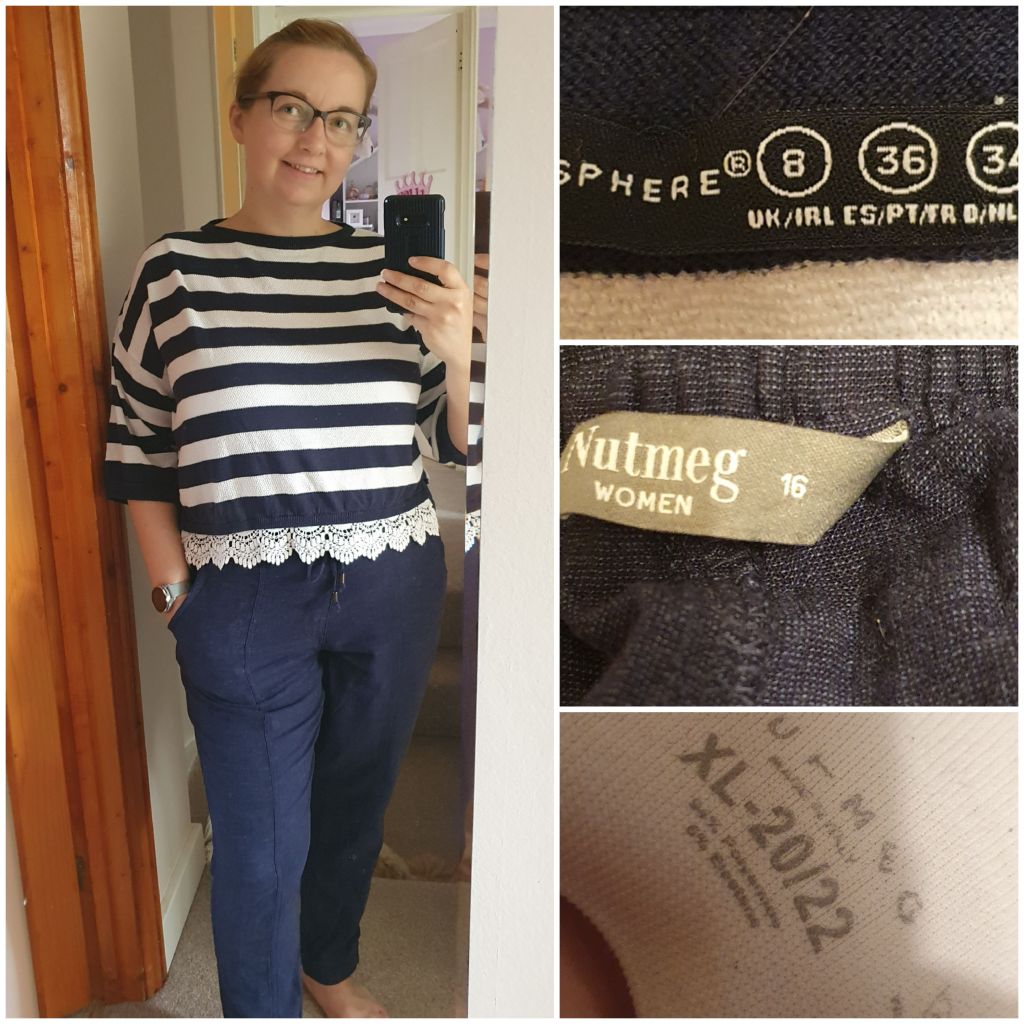
The sun has appeared in the sky today, for the first time in what seems like forever. This is very exciting news! Now, I know we’ve been allowed to go out for a little while now but, to be honest, most days, I haven’t really got anywhere to go. I’m happy pottering about at home most of the time, but not even being able to sit in the garden for most of the month of May has been pretty depressing, even by British standards. So, imagine my delight when Alexa informed me that it was going to be a balmy 17oC today! This did present me with a bit of a dilemma though, as I have *ahem* “outgrown” all of my summer trousers during lockdown and have been wearing stretchy joggers most days. Luckily, I had to pop to Morrisons to pick up some stamps so I grabbed a pair of navy blue linen trousers whilst I was there. When I got home I delved into my wardrobe for a top to go with them and this is where things got interesting (or ridiculous, depending in your point of view).

One outfit, three sizes.

I stood in front of the mirror and realised that the top I was wearing was a size 8 while the trousers I’d just bought were a size 16! A quick check of my crop top/ sports bra revealed that it was a size 20-22! How on Earth could size 22 boobs fit into a size 8 top? Because women’s clothes sizes make no sense, that’s why! When you check the size guide of any given brand (usually available on their websites – good luck finding one instore!) the measurements are given for the bust, waist and hips, so they know what the measurements of the garments are. Why can’t they put them on the labels? We all know which areas of are bodies can cause problems when clothes shopping. For me, it’s my waist as I put all my weight on round my middle. My life would be so much easier if I could reliably shop for jeans by waist size. My husband can. He can go online, filter by waist and inside leg and know that when the jeans arrive, they will fit him perfectly – regardless of where he buys them from. Why are women still put through the ordeal of taking off their perfectly fitting size 12 jeans to try on a different pair of size 12 jeans, only to find they can’t do them up? How difficult can it possibly be to put the measurements on the labels and let us make an informed decision instead of playing the shopping equivalent of Russian roulette every time we need to buy something? No wonder women spend so much longer trying on clothes than men! We have so much less information to go on!

If you find yourself worrying about the numbers on the labels inside your clothes, my advice to you is to just cut them out. Buy clothes that make you feel good and get rid of number that makes you feel bad. Or you could do what I do, and make some of your own clothes – no labels required! If you are trying to get fit or lose weight, I’m not saying you should stop. There are other far more important numbers to worry about though- how many flights of stairs can I manage now? How long did I manage to exercise for today? How many of my five-a-day did I eat? Try and improve those numbers and your health will improve too. By all means, keep track of your waist size if you want to. Waist size is an important indicator of potential risks to your health, after all. Just make sure you use a tape measure and not some arbitrary sizing system that varies wildly from retailer to retailer. Your self-esteem will thank you for it.

Uncategorized

What the heck is a “macro” anyway?

If you have tried to lose weight, get fit, or even just read an article in a magazine recently, there’s a good chance you will have heard of “macros”. Everyone talks about “counting their macros” nowadays, but do you know what they are?

It’s quite simple really. “Macros” is short for macronutrients. That might not help much but it just means the nutrients that we need to consume in large amounts, i.e, proteins, fats and carbohydrates. (as opposed to micronutrients – nutrients we need to eat in small amounts, such as vitamins and minerals).

The average person (not on a special diet due to a medical condition) should aim to get 50-55% of their calories (kcals) from carbohydrates, 30-35% from fats and 10-15% from proteins. You can manually work all this out if you are tracking your food intake – carbohydrates and proteins provide 4kcals per gram whilst fats provide 9kcals per gram. However, it’s a lot easier to use a free app such as myfitnesspal, which also calculates roughly how many calories you should be eating a day (though I will do a post about that later – I want to focus on food quality rather than quantity for now) . If you read my previous post about having a balanced diet and want to start making some adjustments, you might find it helpful to start tracking your food to see where your intake is at the moment. If your macronutrient percentages are roughly okay, then have a look at the foods that make up those numbers and see if there are any healthy swaps you can make e.g, swap white starchy carbohydrates for wholegrain versions. If not, try and reduce things you are having too much of – maybe grill or bake instead of fry to reduce fat – and increase your intake in areas where you are lacking. If you stick to the recommendations in the Eatwell guide your macros can’t go far wrong! I’ve highlighted which foods are good sources of which macros below, but please contact me if you have any questions.

Proteins.

Practically everything has some protein in it. The best sources are eggs, dairy, meat and soya bean, with lentils, chickpeas and wheat not far behind. Proteins are made up of amino acids and there are 9 amino acids we need to eat every day. Animal protein and soya beans contain all of these essential amino acids but if you eat a good variety of foods, you can get all the amino acids you need from other sources.

Fats.

As well making up the bulk of most spreads and oils, fats are also present within foods such as meat, cheese, nuts and seeds, and are added to processed foods such as chocolate and crisps. If you need to reduce your fat intake, try and reduce fats from the sources outside the Eatwell plate (processed foods) rather than cutting down on healthy fats or foods that provide other important nutrients, such as dairy and nuts.

Carbohydrates.

Sugar is a carbohydrate, but you should aim for the bulk of your carbohydrates to be from starchy foods, and ideally from wholegrain sources such as wholemeal bread and brown rice. Fruits and vegetables are also a source of carbohydrate and you should aim to eat at least 5 portions a day. Obviously, fruit is sweet. This is because it contains natural sugar. Unless you are diabetic though, (in which case you need more specialist advice) don’t worry about that too much for now. Get in the habit of choosing healthy snacks first, and we’ll worry about tweaks later. Fruit and veg contain other nutrients and fibre, and will always be a better choice than an unhealthy snack.

So, that’s the gist of “macros”. You can count them if you want to, and if you’ve been advised to eat specific amounts of one or more of them, you might want to get an app to make your life easier. However, you don’t have to. If you want to improve your diet trying to eat in line with the Eatwell Guide is a great start – and there is no maths needed!

I’ll be doing future posts about each of the macronutrients – which one are you most interested to hear about? Let me know below and I’ll do that first!

Uncategorized

A Balanced Diet

You’ve probably heard the term “balanced diet” a million times, but do you know what it really means? There are lots of different definitions out there, but, basically, it means eating a variety of food which gives you all the nutrients you require to stay healthy whilst providing the right amount of energy for your needs . As we are all different, a balanced diet won’t look the same for everyone. Our bodies vary a lot, not only size and shape, but in how they process food and cope with exercise, and our tastes vary wildly too. This will sound obvious, but If you want to make any changes to your diet – either to lose or gain weight, or to try and eat more healthily, it’s important to make sure you eat foods you ENJOY! What I really want to do is to help people understand what it is that they are eating so the can not only make any changes that they need to, but to understand WHY they are making them.

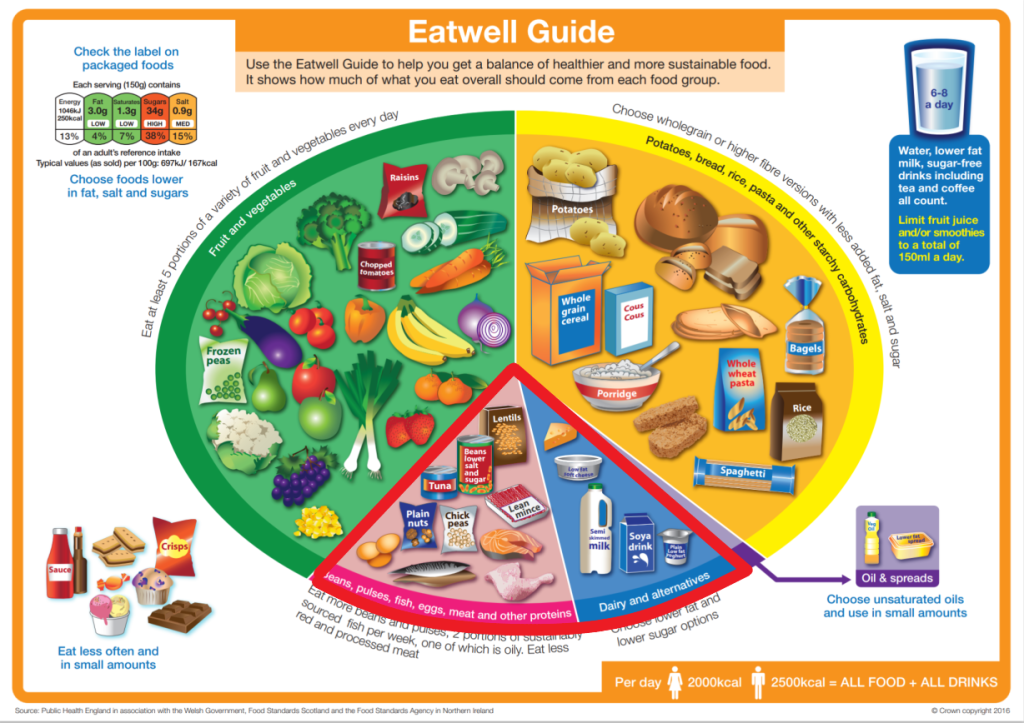
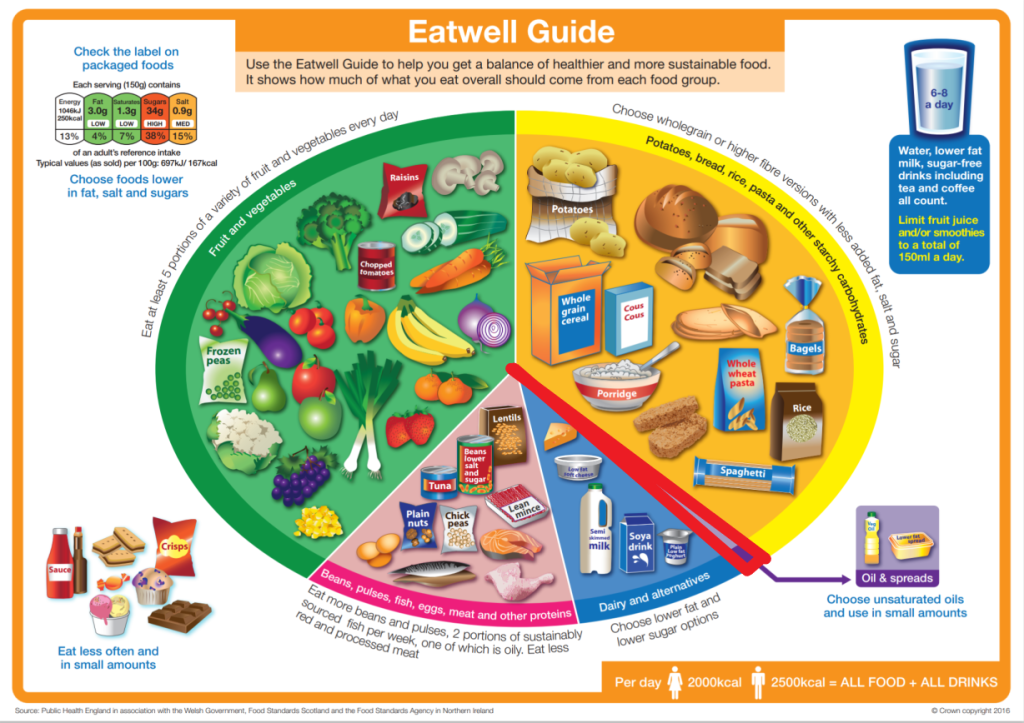
An easy way to see what your diet should look like is to check out the Eatwell Guide

The Eatwell Plate

If you would like to read more about the Eatwell Guide you can do so here

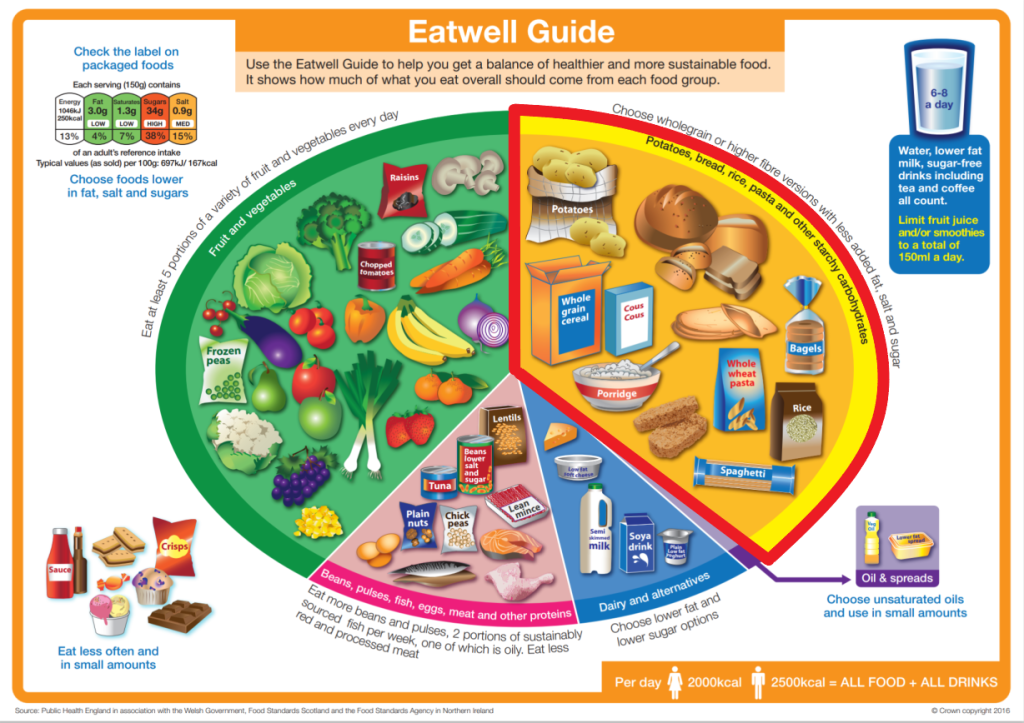
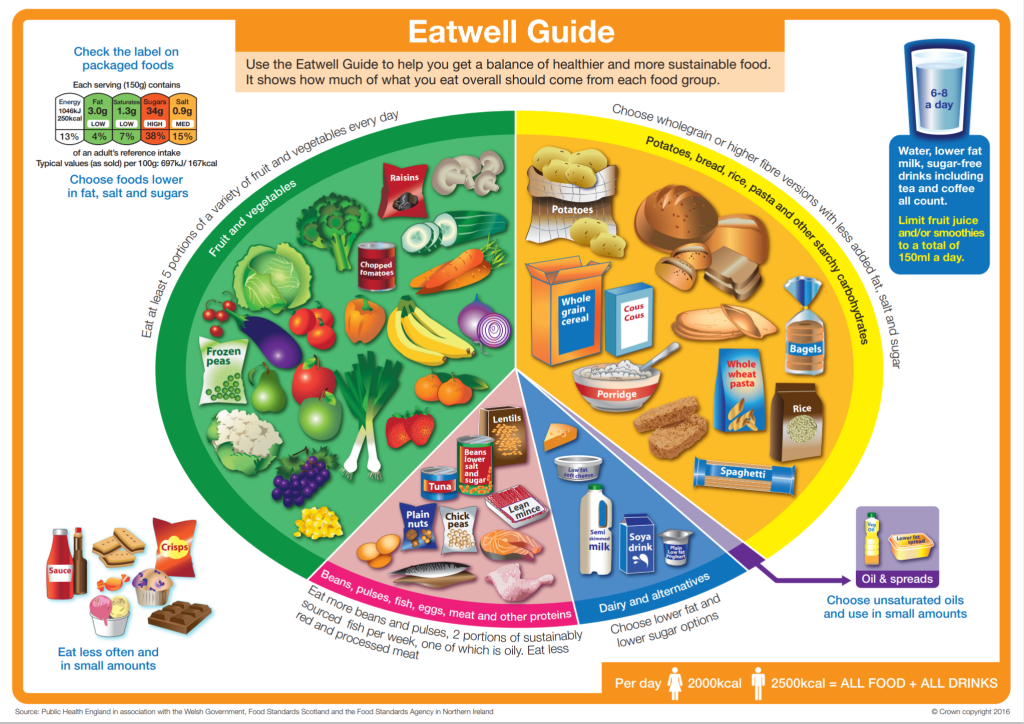
As you can see, the bulk of your diet should be made up of wholegrain or fibre-rich starchy foods and fruit and vegetables, with a smaller proportion made up of protein based foods, and dairy (and dairy alternative) products. Fats and oils should be limited and highly processed foods like crisps and chocolate are shown outside the plate to indicate that they should only be eaten occasionally. I will be sticking broadly to these guidelines so if you’re looking for the latest fad diet, this isn’t the site for you!

In future posts I will talk about the different food groups shown above in more detail, explain the different macro- and micronutrients needed as well as energy requirements for different groups and any other topics that come to mind. This is a very quick intro as I am pretty busy studying for my Level 4 qualification but if you have any questions or topics you’d like me to cover, please get in touch via my facebook or instagram pages. Thanks for visiting my page!

Uncategorized

How my veggie baby became my vegan baby!

So…it’s been AGES since my last post. It’s been a pretty busy year or so. After the chaos of our wedding, followed quickly by the birth of our baby , we gave ourselves a little break before embarking on the next task – moving house! I don’t have any interesting relevant veggie stories about the whole nightmare of house hunting – I’m just mentioning it by way of explanation.

What I want to talk about is the potential difficulties of raising a vegetarian baby. My little one was exclusively breastfed for the first six months of her life and luckily, she and I both found it pretty easy. I am aware that this isn’t always the case and I’m in no way judging anyone who formula feeds. Being a mum is hard enough without being judged by the “breastapo”! She got through the first 6 months of her life with no real problems, except a bit of eczema, predominantly on her face. The problems arose when we started weaning. I tried to make her food from scratch – again, not judging, this was just what I wanted to do. It’s a lot cheaper than buying those tiny jars, for one thing! The one thing I didn’t make was her porridge. I bought baby porridge and it is fortified with vitamins and is more finely milled than regular porridge, so I thought it would be both better and easier for her. Most of the brands I looked at weren’t vegetarian but I managed to find one that was, and had the added bonus of being made up with hot water, whereas the others were made up with the baby’s regular milk which, if you’re breastfeeding means trying to express 200ml a day just for breakfast, on top of whatever volume you need for cooking or bottles.
Most babies start of on a veggie diet of pureed or mashed veg anyway, so she was eating pretty much the same as her little friends in the first few months. We gradually started introducing foods one at a time. All the advice says that this is particularly important if there is a family history of allergies, and I am allergic to nickel and have hay-fever so I was extra careful! When she was about 8 months old I thought I’d try her with some scrambled egg. She absolutely loved it! She wolfed down a whole egg’s worth but then immediately brought it all back up again! She wasn’t a sickly baby so this was quite unlike her. Not wanting to panic too much I called 111 (this is a UK phone number that provides non-emergency medical advice). She had started to go a little bit floppy so I was advised to take her straight to A&E right away and she was given Piriton. After a bit of a wait we saw a paediatrician who told me in no uncertain terms not to “fuck about” next time, and to call an ambulance as my daughter had quite a serious egg allergy! She also said that the eczema on my daughter’s face was likely to be down to a milk allergy. The recommended course of action was to cut both egg and dairy from both of our diets (in case I passed them on via my breast milk). She was absolutely fine by this point so we went home and cleared out the cupboards!

So, that’s how my veggie baby became my vegan baby! This has caused a few challenges, which I’ll tell you all about in due course!